What Is Roller Burn on a Pool Cover and How to Prevent It
You invested in a quality pool cover to protect your pool, retain heat, and cut your running costs. Yet for most of the week that cover sits rolled up on its reel beside the pool, fully exposed to the Australian sun. That is exactly where the damage begins.
Left uncovered on the roller, a pool cover does not simply fade. The layered material traps and magnifies heat until the plastic begins to break down in distinct, repeating lines across the blanket. The cover shrinks. The bubbles deform. The lifespan you paid for is quietly cut short. This is roller burn, and it is one of the most common - and most misunderstood - causes of premature pool cover failure in Australia.
The good news is that roller burn is entirely avoidable. As the pioneers of pool cover and roller technology in Australia since 1989, Elite Pool Covers has seen every form this damage takes, and the prevention is straightforward once you understand the cause. This guide explains what roller burn is, how to identify it, why it happens, whether it is covered by warranty, and the proven steps that stop it for good.
Everything You Need to Know in Under a Minute
- Roller burn is heat damage that occurs when a pool cover is left rolled up on the roller in direct sunlight without a protective over-cover.
- The stacked layers magnify the sun's heat - a rolled cover can exceed 70°C - degrading the plastic in repeating burn lines roughly every 600mm down from the top layer.
- The telltale signs are shrinkage across the width of the cover (usually starting at the corners) and visible melted or damaged lines along the material.
- Roller burn is not a manufacturing fault, so it is not covered by warranty.
- The single most effective prevention is always using a reflective over-cover whenever the pool is not in use.
- A roller burnt cover still works, but its useful lifespan is significantly reduced.
What Is Roller Burn?
Roller burn is the heat damage that occurs when a pool cover is rolled up on the roller and left exposed to the sun without a protective over-cover in place. As sunlight penetrates the rolled material, the temperature climbs progressively through each layer, creating a superheating effect that concentrates at the top of the rolled cover.
This is not surface fading or general weathering. Roller burn is a structural breakdown of the plastic, caused by the cover effectively magnifying the sun's energy onto its own deeper layers. The result is permanent, and it follows a recognisable pattern that sets it apart from ordinary wear.
Because the damage is driven entirely by how the cover is stored rather than by any flaw in the product, roller burn is preventable in every case - which is precisely why understanding it matters.
What Does Roller Burn Look Like?
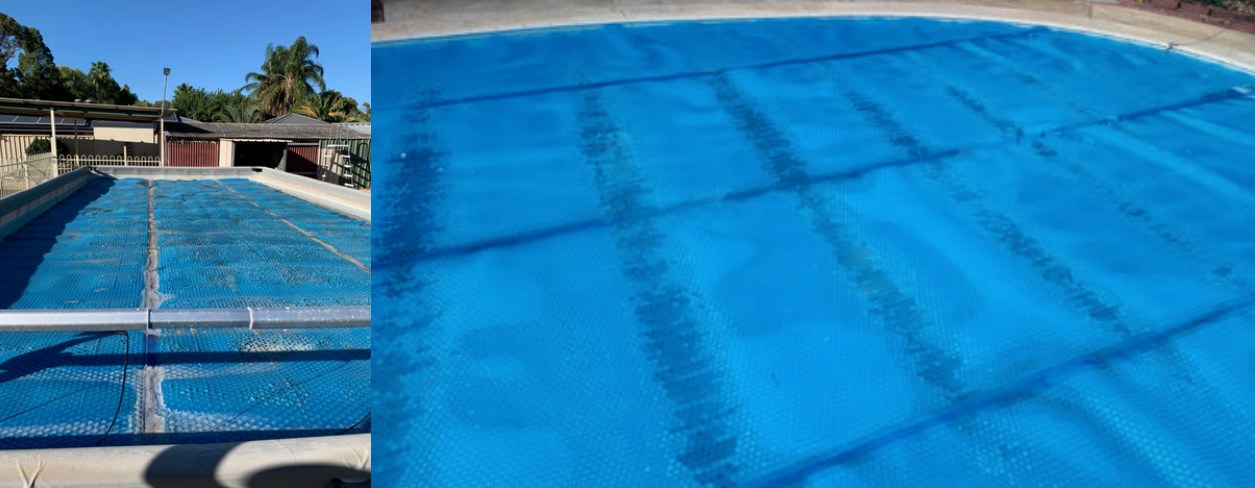
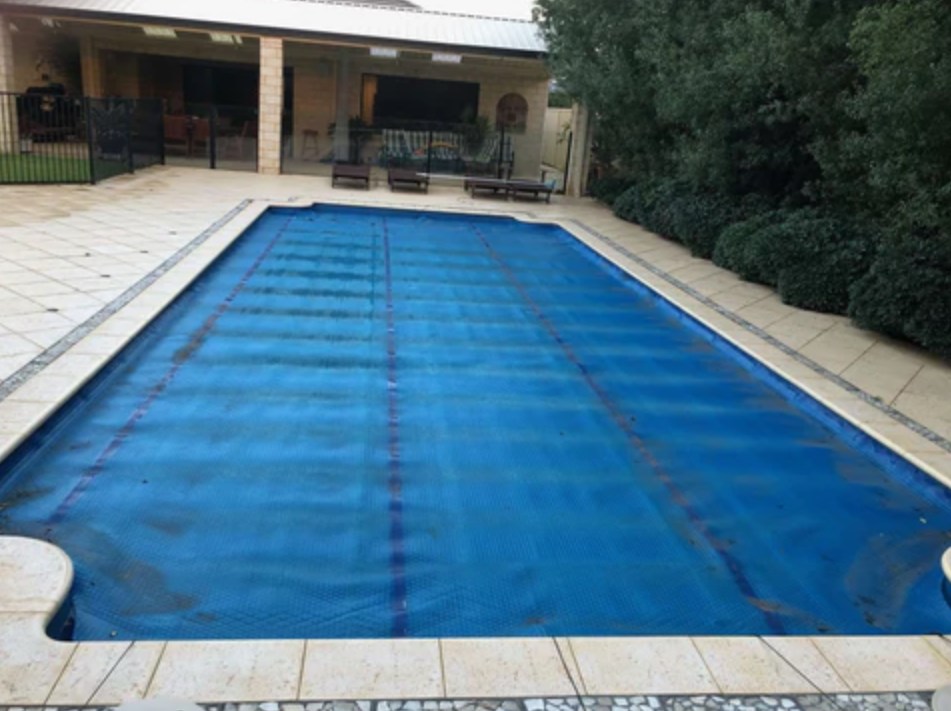
Roller burn presents as a series of melted or distorted lines running across the width of the cover, repeating at regular intervals (around every 600mm) as the layers wrap around the roller. Alongside these lines, the cover often appears to have shrunk, with the corners pulling in first. To an untrained eye it can look like a manufacturing defect, but the repeating, evenly spaced pattern is the signature of heat damage from the roller.
What Causes Roller Burn on a Pool Cover?
The cause of roller burn is heat - specifically, the way a rolled cover concentrates that heat onto itself.
When a solar or thermal cover is wound onto the roller, it forms dozens of tightly stacked layers. Under direct Australian sun, the outer layer absorbs heat and passes it inward, while each successive layer adds insulation that traps the heat rather than releasing it. The temperature inside a rolled cover can climb well beyond 70°C, far higher than the cover ever experiences floating on the water.
At those temperatures the polymer in the cover material begins to soften and degrade. The bubbles in a solar blanket expand under the trapped heat, stretching and permanently deforming the material. Where the layers press together around the roller tube, the most intense heat concentration creates the distinctive burn lines. Australian manufacturer ABGAL describes the same mechanism in its guidance on leaving a solar cover rolled up in the sun, noting that the excess heat causes premature degradation of the plastic in repeating sections across the rolled blanket.
Prolonged ultraviolet exposure compounds the problem. Over time, UV radiation breaks down the cover's polymer structure independently of heat, which is why an unprotected cover deteriorates faster the longer it is left exposed. Our companion guide on protecting your pool cover from heat and UV damage covers the underlying heat-transfer dynamics in detail.
How to Identify Roller Burn on Your Pool Cover
There are two primary indicators of roller burn, and learning to recognise them early can save you from mistaking the damage for a faulty product.
1. Visible burn lines. Roller burn lines are easy to identify once you know what you are looking for. The heat shrinks and damages the cover material in melted or distorted lines that run across its width, repeating at regular intervals (around every 600mm) and typically beginning from the second layer down. These lines are evenly spaced because they correspond to each wrap of the cover around the roller.
2. Width shrinkage. A small amount of lengthwise shrinkage - up to around 2% - is normal and occurs naturally during manufacturing. Shrinkage across the width of the cover is a different matter and is a strong sign of roller burn. This width shrinkage usually begins at the corners, where the heat-affected material draws inward first.
Is Width Shrinkage Always Roller Burn?
Not always, but it is the most common cause. A minor degree of length shrinkage is expected and built into how covers are manufactured. When the cover starts pulling in across its width - particularly from the corners - and this is accompanied by repeating burn lines, roller burn is almost certainly the cause. If the cover has been stored rolled up in the sun without an over-cover, you can be confident in the diagnosis.
In the short term, surprisingly little. A cover affected by roller burn will generally continue to float, retain heat, and reduce evaporation. The shrinkage and burn lines are unsightly, but they do not immediately stop the cover from doing its job.
The real consequence is lifespan. Roller burn permanently weakens the cover material, and that damage accumulates with every additional day of unprotected exposure. A cover that should deliver many years of service can have its useful life cut dramatically short. The cost of that shortened lifespan - in earlier replacement and lost performance - far outweighs the cost of preventing the damage in the first place. For a sense of what replacement involves, our guide to pool cover costs in Australia sets out the full range.
Is Roller Burn Covered by Warranty?
No. Roller burn is not a manufacturing defect - it is the result of how the cover has been stored and used. Because the damage is caused by leaving the cover exposed to the sun on the roller rather than by any flaw in the product, it is not a warranty issue. This is one of the most important things for any pool owner to understand: the responsibility for preventing roller burn sits with how the cover is protected day to day, and the prevention is simple.
How to Prevent Roller Burn
Roller burn is one of the few forms of pool cover damage that is almost entirely within your control. The prevention comes down to a single, non-negotiable habit, supported by a few sensible practices.
⚠️
Always use your reflective over-cover whenever the pool is not in use.
A purpose-made over-cover deflects 90-95% of UV radiation and shades the rolled blanket completely, stopping heat from building in the layers. This is the single most effective step you can take to prevent roller burn.
Beyond the over-cover, the following practices protect your cover further:
- Demand complete shade. Partial shade is not enough - the cover needs 100% coverage. A reflective over-cover that fully encloses the rolled blanket prevents the heat concentration that causes burn lines.
- Allow ventilation. Adequate airflow around the rolled cover helps dissipate heat rather than letting it accumulate.
- Handle in cooler hours. Roll and unroll the cover in the cooler parts of the day - early morning or evening - rather than at peak heat.
- Remove the cover in extreme heat. When surface temperatures climb beyond around 38°C, taking the cover off the roller and storing it out of direct sun avoids the worst of the heat build-up.
For the complete maintenance routine that keeps a cover performing season after season, see our guide on caring for your new pool cover. Specialist suppliers reinforce the same principle internationally - the In The Swim solar blanket care guide recommends covering the rolled blanket with a fitted reel cover to shield it from heat and UV.
Roller Burn vs Normal Pool Cover Wear
It helps to know which signs point to roller burn and which are simply part of a cover's normal life.
| Characteristic |
Roller Burn |
Normal Wear |
| Pattern |
Repeating melted or damaged lines (around every 600mm) |
Even, gradual fading across the surface |
| Shrinkage |
Across the width, starting at the corners |
Slight lengthwise shrinkage (up to ~2%), built into manufacturing |
| Cause |
Heat trapped in the rolled cover under direct sun |
General ageing, normal use, and sun exposure over years |
| Preventable |
Yes - with a reflective over-cover |
Slowed with good care, but a natural part of lifespan |
| Warranty |
Not covered |
Not covered |
Choosing a Pool Cover and Roller Built to Last
Preventing roller burn starts with good habits, but it is supported by quality equipment engineered for Australian conditions. A well-made cover paired with the right roller and over-cover gives you the best defence against heat and UV damage.
Elite manufactures a complete range of pool covers built to withstand demanding Australian conditions, including high-performance solar pool covers for passive heating, thermal pool covers engineered for heat retention, and winter pool covers for the off-season. Our specialised Salt Safe® and Chlor Safe™ blankets are built to resist damage from Australia's demanding pool chemistry environments.
The roller you choose matters just as much. Elite's pool cover rollers are manufactured for durability and ease of use, with options to suit every pool, including above-ground, below-ground, automatic, mobile, stationary, and bench seat pool cover rollers. Matching the right roller and over-cover to your blanket is the foundation of a setup that lasts. If you are setting up from scratch, our ultimate guide to buying and fitting a pool cover and roller walks through every step, and our overview of why a pool cover is worth it explains the broader benefits of covering your pool.
Elite Pool Covers: Australia's Pioneer Pool Cover Specialists Since 1989
Established in Perth, Western Australia in 1989, Elite Pool Covers has spent more than 35 years pioneering pool cover and roller technology in Australia. Proudly Australian owned and operated, Elite supplies both the public and the pool industry, exports to New Zealand, South Africa, Spain, France, and the United Arab Emirates, and delivers nationwide with dedicated ranges for Melbourne, Sydney, Brisbane, the Gold Coast, the Sunshine Coast, Perth, Adelaide, and Canberra.
Elite was the first Australian company to design and manufacture an automatic pool cover, all-aluminium commercial rollers, and an in-ground hideaway roller system. That engineering pedigree saw Elite chosen from a field of international companies to cover the pools for two World Swimming Championships at Challenge Stadium - building Australia's first commercial motorised winding system to do so - and has since been applied at HBF Stadium, Fiona Stanley Hospital, and Perth Children's Hospital.
The outcomes from the facilities and pool owners who have chosen Elite Pool Covers speak for themselves:
"Purchased my pool cover and roller for a 60,000ltr pool in July 2004 and it's still going strong."
- J O'Hehir, NSW (ProductReview)
"Bought our pool cover 10 years ago from Elite and it is still going strong."
- Sue Diamond, WA (ProductReview)
"Very happy with the knowledgeable and helpful staff. Always willing to take the time to explain."
- Rod G. (ProductReview)
Frequently Asked Questions About Roller Burn
Can You Fix Roller Burn on a Pool Cover?
No. Roller burn permanently degrades the cover material, and the damage cannot be reversed. Once the plastic has been heat-damaged in burn lines and the cover has shrunk across its width, those changes are permanent. The only effective approach is prevention - protecting the cover with a reflective over-cover before the damage occurs.
How Long Should a Pool Cover Last Without Roller Burn?
With proper care and consistent use of an over-cover, a quality pool cover can deliver many years of reliable service - Elite covers are regularly still in service well beyond a decade. Roller burn is one of the main reasons covers fail earlier than they should, which is why protecting the rolled cover from heat is so important to getting full value from your investment.
Does Roller Burn Mean My Cover Is Faulty?
No. Roller burn is not a manufacturing fault and does not indicate a defective product. It is caused by storing the cover rolled up in direct sunlight without protection. Because it results from how the cover is used rather than how it was made, it is not a warranty issue.
Do I Need an Over-Cover if My Roller Is in the Shade?
Yes. Partial or moving shade is not sufficient, because the cover needs complete coverage to stay protected throughout the day as the sun moves. A reflective over-cover guarantees 100% shade and deflects the UV radiation that degrades the material, regardless of where the roller is positioned.
Protect Your Pool Cover Investment
Roller burn is permanent, it shortens the life of your pool cover, and it is not covered by warranty - but it is also one of the easiest forms of damage to prevent. The cause is heat trapped in a cover left rolled up in the sun, and the solution is to keep that cover protected.
The essentials are simple:
- Always use a reflective over-cover whenever the pool is not in use.
- Demand 100% shade coverage, not partial shade, and allow ventilation around the rolled cover.
- Handle the cover in cooler hours and remove it from the roller in extreme heat.
- Pair a quality cover with the right roller and over-cover engineered for Australian conditions.
Protect the cover, and it will protect your pool - and your investment - for years to come.
Get A Quote Today
Need specific pricing for your pool? Elite Pool Covers are Australian leaders in swimming pool covers and roller technology. Give us a call on (08) 9240 2262 or request a personalised quote, to receive accurate pool cover pricing tailored to your unique requirements.