How to Measure Your Pool Accurately for the Perfect Cover Fit
Have you ever ordered a pool cover online only to discover it doesn't fit properly when it arrives? Getting pool measurements wrong is one of the most frustrating and expensive mistakes Australian pool owners make, often resulting in ill-fitting covers that waste money and provide inadequate protection.
Undersized covers leave portions of your pool exposed to debris and evaporation, while oversized covers create safety hazards and look unprofessional. You end up paying for expensive alterations, complete replacements, or settling for substandard protection that defeats the entire purpose of investing in a quality pool cover.
This guide reveals the exact methods used by industry professionals to measure pools of all shapes and sizes, ensuring your solar pool blanket, pool cover roller, or thermal pool cover fits perfectly and delivers maximum protection and value.
Here's What You Need to Know in Under a Minute
- Measure at water level from inside pool walls for accurate dimensions
- Treat complex pools as rectangles for cover sizing calculations
- Record length, width, and any step areas separately for custom manufacturing
- Use a string or a rope to form rectangles around irregularly shaped pools
- Take photographs of unusual pool shapes for manufacturer consultation
- Measure twice to ensure accuracy before placing your order
- Professional measurement services are available for complex installations
- Custom welding accommodates steps and unique pool features in a single cover
Pool Measurement Fundamentals
Accurate pool measurement forms the foundation of successful cover installation, equipment sizing, and chemical management for Australian pool owners and facility managers.
Why Accurate Measurements Matter
Pool measurements directly impact several critical aspects of pool ownership:
- Cover fit ensures complete protection and optimal appearance
- Chemical calculations determine proper dosing for water balance
- Equipment sizing selects appropriate pumps, filters, and heaters
- Cost accuracy prevents expensive ordering mistakes and alterations
- Safety compliance ensures that covers meet safety standards and regulations
Measurement Reference Points
Professional pool measurement relies on consistent reference points every time:
- Water level means all measurements are taken at the normal operating water level
- Inside walls mean measuring from interior pool surfaces, not coping or decking
- Maximum dimensions means recording the longest length and the widest width points
- Step areas are measured separately, with their relative positions noted
The Rectangle Principle
Regardless of the actual pool shape, cover manufacturers work with rectangular dimensions. This simplifies manufacturing, reduces costs, ensures coverage across the entire pool perimeter, and allows covers to be trimmed to exact shapes after delivery.
Australian Pool Standards
Local conditions influence measurement requirements. Some council areas require specific overhang dimensions for safety compliance. Australian wind conditions may require additional securing allowances, and overhang sizing affects both shade coverage and drainage around pool edges.
How to Measure Your Pool
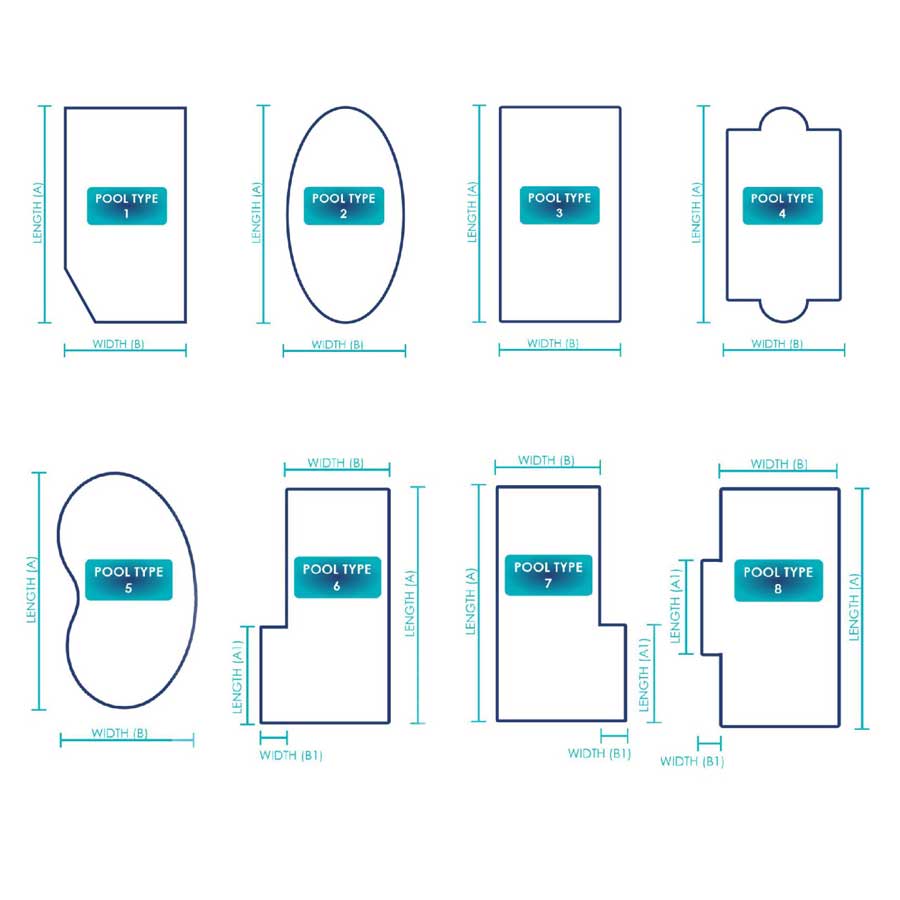
The best way to measure your pool is to think of it as a rectangle — that is, longest length by longest width.
For standard pool shapes (pools 1–5 in the diagram below), a single rectangle measurement covers the entire pool. Simply record the longest length and the longest width at water level.
If your pool includes steps or an L-shaped extension (pool types 6 onwards), divide the pool into two rectangles as shown in the diagram. Measure each rectangle separately, then add the two measurements together to arrive at the total square meterage.
Required Measuring Tools
- 25–30 metre fibreglass tape measure (won't stretch or sag over long distances)
- String or rope (50+ metres for forming rectangles around irregular pools)
- Waterproof marker
- Notebook and pen (weather-resistant materials)
- Digital camera or smartphone
- Calculator
Optional Professional Tools
- Laser distance meter (precise measurements over long distances)
- Water level indicator
- Measuring wheel (useful for very large commercial pools)
- Smartphone measurement apps
Pre-Measurement Preparation
Before you start, ensure the pool is at its normal operating water level, and the water is clear enough to identify edges and steps. Remove pool furniture and equipment from measurement areas, and use appropriate footwear on wet surfaces.
For pools over 10 metres, you'll need a second person to hold the far end of the tape measure and confirm endpoint positions. Avoid measuring in strong wind or heavy rain, as both affect accuracy and safety.
Measuring Rectangular and Square Pools
Rectangular and square pools are the simplest to measure, yet accuracy is still critical for a proper pool cover fit.
Step-by-Step Measurement
- Position the tape measure at one short end of the pool at water level and extend to the opposite end in a straight line. Record to the nearest centimetre.
- Repeat from the opposite direction to verify.
- Measure the width at the widest point, keeping the tape perpendicular to the length.
- Take diagonal measurements across both corners. Equal diagonals confirm a true rectangle.
Common Rectangular Pool Variations
| Variation |
How to Handle It |
| Slightly irregular rectangle |
Always record the longest and widest points |
| Rounded corners |
Measure to the widest points, ignoring radius curves |
| Cut corners |
Measure maximum length and width |
| Entry steps |
Measure the main pool body and document step areas separately |
��
Pro tip
Maintain consistent tape tension throughout. Even a slight sag over 10+ metres will add centimetres of error to your measurement.
Handling L-Shaped and Stepped Pool Areas
The Two-Rectangle Method for L-Shaped Pools
L-shaped pools are measured as two separate rectangles that combine for total coverage. Measure the larger main pool area first, then the smaller extension as a separate rectangle. Note the position of the secondary section relative to the main pool (left, right, shallow end, or deep end) and document any overlap between the two areas.
Measuring Step Areas
Steps built into pool walls need individual attention:
- Internal steps should be measured separately for length and width, with left/right/corner/centre position noted
- External step-outs are treated as an independent rectangular section; document how each connects to the main pool
- Attached spas require independent measurements for the spa and pool areas, plus notes on spillway or connection details
String Method for Stepped Sections
For irregular step configurations, use a string to form a rectangle around the section, mark the corners, then measure the rectangle dimensions. Photograph the string layout so the manufacturer can reference it clearly.
Complex Pool Shapes and Irregular Designs
Kidney-Shaped Pools
Create a rectangular envelope around the entire kidney shape by measuring the furthest points end-to-end for length and the widest point across the curves for width. These two dimensions form your manufacturing rectangle. Always photograph the curved areas to send to your pool cover manufacturer.
Free-Form Pools
For highly irregular shapes, the string rectangle technique works best:
- Place rope around the pool at its maximum extent points
- Adjust the rope to form the smallest rectangle that contains the entire pool
- Mark the rectangle corners
- Measure the rope rectangle length and width
- Photograph from multiple angles before removing the rope
Rock-Edge and Natural Pools
Measure at the normal operating water level rather than the rock edge. Ensure the entire water surface area is covered by your measurements, and document any rock shelves or natural features that could affect how the cover sits.
Commercial and Resort Pools
Large pools with multiple use areas (lap lanes, recreation zones, therapy sections) may require a professional survey or CAD documentation. Spillways and water features also need specific accommodation in the cover design, so always note these during your site assessment.
Professional Measurement Techniques and Common Mistakes
The Three-Check System
Industry professionals verify every measurement using three passes:
- Initial measurement using the primary method
- Verification measurement from the opposite direction
- Cross-check using an alternative technique (e.g., laser vs tape)
Measurements within 5cm are acceptable. Larger discrepancies require resolution before ordering.
Advanced Verification Methods
- Triangulation uses fixed reference points around the pool perimeter and trigonometry to verify dimensions
- A grid system is used for large commercial pools, where a coordinate grid maps the pool outline
- Laser integration provides millimetre-accurate readings for difficult-to-access areas with direct transfer to design software
Documentation Standards
Professional records include complete dimensions with verification notes, reference photographs showing measurement start and end points, and client sign-off before manufacturing begins. For complex pools, senior technicians review all measurements before the order is submitted.
Common Measurement Mistakes and How to Avoid Them
| Mistake |
Consequence |
Prevention |
| Measuring at deck level instead of water level |
The cover is sized incorrectly for the actual water surface |
Always measure at the normal operating water level |
| Treating L-shaped pools as simple rectangles |
Areas of the pool left uncovered |
Use the two-rectangle method |
| No overhang allowance |
Cover too small to secure around the perimeter |
Add 200mm width and 300mm length allowances |
| Tape sag during long measurements |
Inaccurate dimensions |
Use fibreglass tapes and maintain consistent tension |
| Measuring alone on large pools |
Tape position shifts, giving false readings |
Always use a two-person team for pools over 10 metres |
| Not documenting step positions |
Cover doesn't accommodate steps properly |
Record step dimensions and position relative to shallow/deep end |
| Single measurement, no verification |
Undetected errors result in poor cover fit |
Measure each dimension at least twice and cross-check |
Custom Manufacturing Process
Once your measurements are confirmed, Elite Pool Covers converts them into detailed manufacturing specifications using CAD software. Their custom welding capabilities allow multiple sections to be joined into a single seamless cover, including step areas, attached spas, and unusual shapes.
Material Selection for Australian Conditions
Materials are selected specifically for local climate challenges:
- Advanced UV stabilisation for harsh Australian sunlight
- Salt Safe® and Chlor Safe™ formulations that resist pool chemical damage
- Commercial-grade construction rated for extreme heat conditions
Quality Assurance Before Delivery
Every cover is inspected against its measurement specifications before dispatch. Welding seams are tested for strength and appearance, and each cover is packaged to prevent shipping damage. Elite backs custom covers with guarantees covering dimensional accuracy, material performance, and manufacturing quality.
Volume Calculations and Cover Sizing by Pool Type
Precise pool measurements also enable accurate volume calculations for chemical dosing, equipment sizing, and energy efficiency.
Basic Volume Formulas
| Pool Shape |
Formula |
Example |
| Rectangular |
L × W × Avg Depth × 1,000 |
10m × 5m × 1.5m × 1,000 = 75,000 L |
| Circular |
π × Radius² × Avg Depth × 1,000 |
3.14 × 3² × 1.2m × 1,000 = 33,912 L |
| Oval |
L × W × 0.785 × Avg Depth × 1,000 |
12m × 6m × 0.785 × 1.8m × 1,000 = 101,412 L |
| Kidney (approx) |
Max L × Max W × 0.75 × Avg Depth × 1,000 |
Verify against water meter reading |
Practical Applications
- Chlorine dosing at a 3ppm target for a 75,000L pool requires approximately 225g liquid chlorine
- Pump sizing requires the pool volume to circulate every 6 to 8 hours, which means a minimum of 12,500 L/hr for a 75,000L pool
- Salt systems are sensitive to volume errors: a 10% volume error produces a 10% salt dosing error, affecting the chlorinator cell output
- Heater sizing requires approximately 334 BTUs per litre for a 1°C temperature rise, with an extra 25% capacity recommended for Australian evaporation rates
Cover Sizing for Different Pool Types
Residential Pools
Family pools need a minimum 300mm overhang for child safety compliance. Step areas should be integrated into the main cover or covered separately. For luxury pools with automated systems, precise sizing is essential as automated rollers have tighter tolerances than manual installations.
Commercial and Public Pools
Public pool covers must comply with strict safety regulations and allow for rapid emergency removal. Sizing should account for multiple access points and heavy-duty materials that are thicker and heavier than residential grades.
Climate-Specific Sizing
| Region |
Key Consideration |
| Tropical (Northern Australia) |
Enhanced overhang for UV shade, cyclone-resistant securing allowances, and drainage capacity for heavy rainfall |
| Temperate (Southern Australia) |
Wind-resistant anchoring, frost protection for alpine areas, and seasonal removal allowances |
Material-Specific Sizing Notes
Digital Tools and Measurement Apps
Smartphone Options
- Measure (iOS) is Apple's built-in AR tool for basic pool dimensions
- RoomScan Pro offers professional-grade measurement with CAD export
- MagicPlan creates scaled floor plans from smartphone photos
- Pool Volume Calculator provides dedicated volume calculations from your measurements
⚠️
Important
Smartphone AR measurements have ±5–10cm accuracy, which is useful for preliminary estimates only. Always verify with a physical tape measure before placing a pool cover order.
Professional Digital Tools
Laser distance meters offer ±2mm accuracy up to 100 metres and can transfer readings directly to design software via Bluetooth. Digital tapes with built-in memory functions are also useful for recording multiple dimensions on-site without needing a second person to write them down.
Cost vs Value
Professional laser tools typically cost between $200 and $800. The investment pays for itself quickly if it prevents a single incorrect pool cover order, which can cost $2,000 or more to rectify.
When to Seek Professional Measurement Services
Situations That Require Professional Measurement
- Pool cover investment exceeding $5,000
- Complex or unusual pool shapes
- Multi-level pools with significant elevation changes
- Commercial or public facilities
- Child safety or life-safety cover applications
- Automatic cover systems (typically $15,000+)
- Remote locations where installation errors are costly to correct
What Professional Services Include
A professional site measurement typically includes certified, accurate dimensions, complete technical documentation for manufacturing, installation planning, and a measurement accuracy guarantee backed by professional liability insurance.
Value Analysis
Professional measurement for a high-value installation protects against $2,000–$10,000 in potential errors. It also protects warranty coverage, satisfies council and insurance requirements, and provides peace of mind that the cover will fit correctly on the first installation attempt.
How Elite Pool Covers Helps You Get It Right
Measuring your pool accurately is only half the equation. Having a manufacturer who can translate those measurements into a cover that fits perfectly is what makes the difference between a frustrating experience and a result you're genuinely happy with. Elite Pool Covers has been doing exactly that for Australian pool owners for over three decades.
Free Measurement Support
Not sure whether your measurements are correct? Elite Pool Covers offers free measurement consultations for all customers. Whether you have a straightforward rectangular pool or a complex free-form shape, their team can walk you through the process, review your dimensions, and flag anything that looks off before your order goes into production. This alone prevents the majority of costly mistakes.
Professional On-Site Measurement
For complex pool shapes, high-value cover systems, or any situation where getting it right the first time matters most, Elite Pool Covers provides professional on-site measurement services across Australia. Their technicians use calibrated equipment and follow the same three-check verification process described in this guide, with every measurement backed by a fit guarantee.
Custom Welding for Any Pool Shape
Elite Pool Covers pioneered custom pool cover welding in Australia. Rather than forcing an irregular pool into a standard size, their manufacturing team builds the cover around your specific dimensions. Steps, spas, unique curves and unusual configurations are all accommodated within a single seamless cover rather than patched together with separate pieces. The result looks professional and performs better over the long term.
Covers Built for Australian Conditions
Every cover Elite Pool Covers manufactures is built specifically for the Australian climate. Materials are UV-stabilised for prolonged sun exposure, and both Salt Safe® and Chlor Safe™ formulations are available to suit whatever sanitising system your pool runs on. Whether you need a solar pool blanket, a thermal pool cover, or a pool cover roller to go with it, everything is designed to work together from day one.
What to Have Ready When You Call
When you get in touch with Elite Pool Covers, having the following information prepared will help the team give you an accurate quote as quickly as possible:
- Pool length and width measured at water level
- Step area dimensions and their position (left, right, shallow end, or deep end)
- Photos of the pool from each end and both sides
- Notes on any attached spa, water feature, or unusual feature
- The type of cover you are interested in
Call Elite Pool Covers on (08) 9240 2262 or 1300 136 696 or request a personalised quote online to get started.
Frequently Asked Questions
What is the most important measurement to get right?
The water-level dimensions. Always measure length and width at the normal operating water level from inside the pool walls, not from the deck or coping. This ensures your cover fits the actual water surface area.
How much overhang should I add to my pool measurements?
Standard allowances are 200mm for width and 300mm for length. This provides adequate material for secure attachment while accommodating minor measurement variations.
Can I measure my irregularly shaped pool myself?
Yes, using the string rectangle method. Place rope around your pool's perimeter to form the smallest rectangle that completely contains the pool, then measure the rope rectangle dimensions. For complex shapes, consider professional measurement to ensure accuracy.
Should I measure my pool steps separately?
Yes. Always measure step areas separately and document their position relative to the main pool (left/right side when facing the shallow or deep end). Steps can be integrated into a single welded cover or covered separately, depending on your requirements.
How accurate do my measurements need to be?
Aim for accuracy within 5cm. Significant errors can result in coverage gaps or a cover that can't be secured properly. If two attempts differ by more than 10cm, re-measure carefully before ordering.
Do I need a professional measurement for my pool cover?
Professional measurement is recommended for cover investments over $5,000, complex shapes, commercial applications, or safety-critical installations. Simple rectangular residential pools can often be measured accurately by homeowners following the steps in this guide.
What if my measurements differ between attempts?
Re-measure using a careful technique, ensuring consistent reference points and proper tape tension. Differences of more than 10cm indicate a technique issue that needs to be resolved before placing an order.
How long does the measurement process take?
Simple rectangular pools take 15 to 30 minutes. Complex shapes with steps or irregular configurations may require 1 to 2 hours. Professional services typically complete residential pools in 2 to 4 hours, including documentation.
What if my cover doesn't fit due to a measurement error?
Quality manufacturers like Elite Pool Covers work with customers to resolve fitting issues. Professional measurements typically include guarantees, while DIY measurement errors may require cover modifications or replacement at additional cost.
Maximising Your Pool Cover Investment
Proper pool measurement isn't just about getting the right dimensions on paper. It's about protecting a significant investment while ensuring your family enjoys safe, efficient pool operation for years to come. By following the measurement techniques outlined in this guide, Australian pool owners can expect their covers to perform optimally throughout their design life while delivering maximum energy savings, debris protection, and convenience.
Remember that quality pool covers from established manufacturers like Elite Pool Covers are designed to withstand Australia's challenging conditions when properly measured and installed. The key lies in taking accurate measurements from the start, verifying them more than once, and working with a manufacturer who understands how to bring those dimensions to life.
Get An Elite Pool Covers Quote Today
Need specific pricing for your pool? Elite Pool Covers are Australian leaders in swimming pool covers and roller technology. Give us a call on (08) 9240 2262 or request a personalised quote, to receive accurate pool cover pricing tailored to your unique requirements.